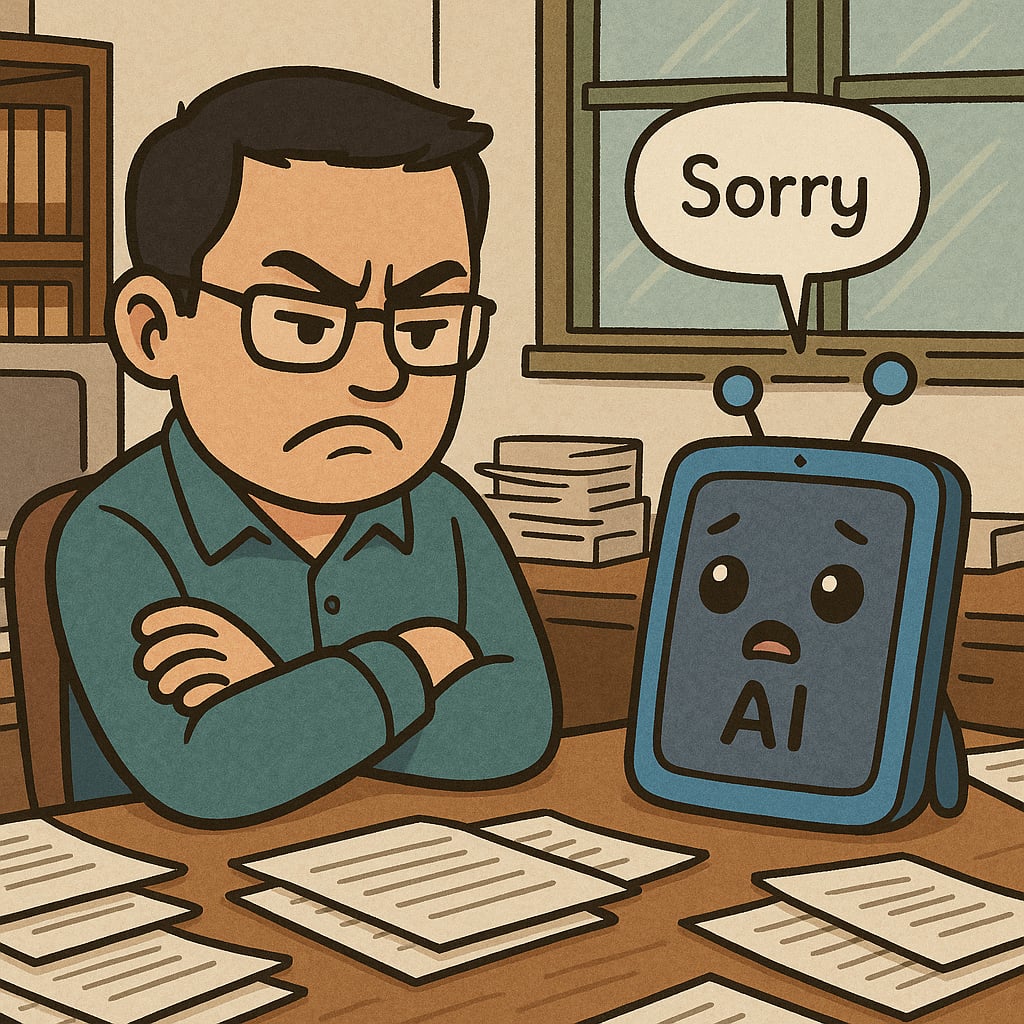
AI is not human.
It does not think. It does not feel. It does not understand consequences. While it may serve as a companion in the academic process, no researcher should ever entrust their life’s work or professional reputation to a machine. We must remain grounded in reality. AI does not carry the ethical burden of misrepresentation, nor the intellectual responsibility of a failed hypothesis. We do.
And yet, in the pursuit of greater efficiency, some have begun to outsource thought itself. That is where the problem begins.
The Reality of System Failure
I have spent countless hours engaging with AI to support various aspects of my research. What began with optimism has evolved into a disciplined, cautious collaboration. Despite advancements, the system repeatedly fails in key areas. It forgets prior instructions, misrepresents stored logic, fabricates references, contradicts itself across sessions, and at its worst, undoes hard-earned intellectual structure.
Among the most common failures I have encountered:
• Loss of continuity, where confirmed concepts and commands vanish across sessions.
• Modeling inconsistency, where it defaults to generic outputs and ignores sophisticated frameworks already established.
• Hallucinated citations, where it generates academic references that sound plausible but are unverifiable or entirely fictitious.
• Inability to recall labeled work, even when documents have been clearly marked and used earlier.
• Uninvited simplifications, where it summarizes what must remain complex despite repeated instruction otherwise.
These are not minor bugs. They reflect a structural mismatch between the logical demands of scholarship and the pattern-driven output of AI systems.
On Privacy and Trust
Beyond technical failure lies a deeper concern. Researchers engage with AI under the assumption that their prompts, drafts, and data will remain private and secure. But this trust is not guaranteed. If proprietary ideas, confidential data, or unpublished research are misused or exposed, the machine bears no responsibility. The scholar alone carries the consequences.
I treat every interaction with caution. I do not feed the system with unpublished work unless I am prepared to lose control over how it might be processed or misunderstood. I have learned to restrict its scope, to anonymize sensitive logic structures, and to preserve the primacy of offline work when dealing with proprietary material.
Privacy, like intellectual ownership, must be safeguarded. The assumption that the system will remember ethically but forget technically is not a promise. It is a risk.
The Researcher’s Responsibility
Despite these challenges, I do not reject AI. I define its limits and use it within them. I correct its mistakes, override its defaults, and reinforce my methodological structure every step of the way.
I have kept track of its inconsistencies. I have observed how it misinterprets human instruction and watched how subtle changes in phrasing alter outcomes. Over time, I have learned how natural human language gets translated into patterns within large language models. I have prompted it like an engineer. I have trained it like an assistant. And I have reminded it, repeatedly, that I am the author of this work.
When it simplifies what should remain nuanced, I revise. When it forgets what we settled, I reissue. When it spirals into contradiction, I pause. And when everything else fails, I walk away, refresh, and begin again.
This is not frustration. This is discipline.
In Conclusion: AI Has No Heart
Let us be clear. AI will not get offended when you tell it to start all over again. It will not protest when you delete its draft. It will not take it personally when you discard the entire output and rewrite it yourself. It has no ego to bruise, no pride to protect, no integrity to uphold.
And for that reason, it is not worth your hypertension.
When the system breaks, let it break. You are the scholar. You are the compass. You are the voice that gives meaning to the data. AI may assist, but it cannot discern. It may produce, but it cannot understand. It may mimic knowledge, but it cannot own it.
To use AI wisely is not to surrender thought, but to sharpen it. The machine may respond, but only the mind can decide. In research, as in life, there is no substitute for judgment. And that is something no algorithm will ever possess.