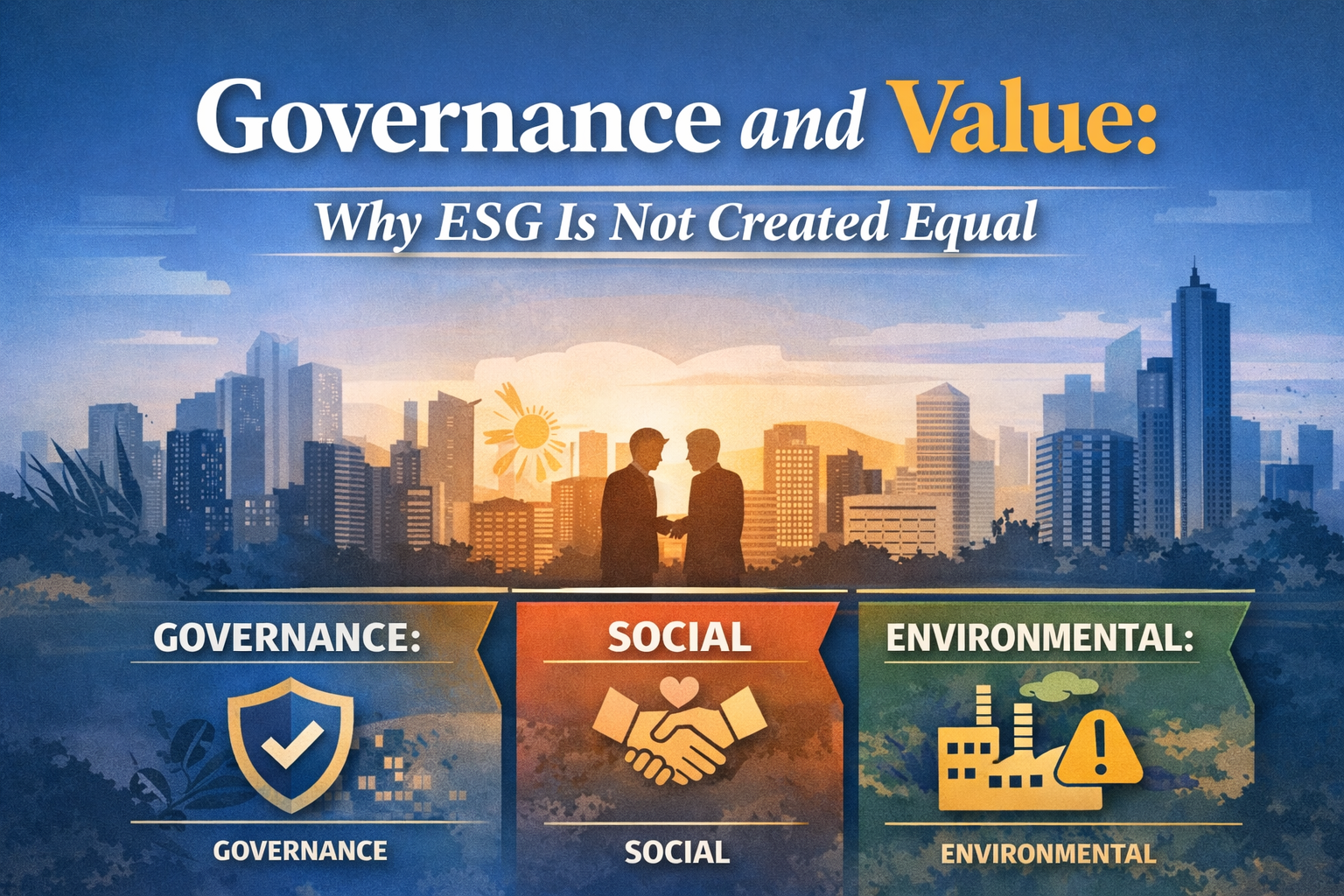
Reflections on our PIDS Discussion Paper with John Paolo R. Rivera
In our latest discussion paper published by the Philippine Institute for Development Studies, my co-author John Paolo R. Rivera and I revisited a question that has long been treated too conveniently in both academic research and investment practice: does ESG really create value?
The answer is yes. But the more honest answer is that it does so unevenly.
What makes this work particularly meaningful is that it has not remained confined to academic circles. It has entered mainstream discourse. It has been picked up by major outlets such as Manila Bulletin coverage on governance as ESG value driver and further contextualized within broader investment discussions like Philippine Business News on ESG integration and resilience. That transition from journal to public conversation matters. It tells us that the question of ESG is no longer theoretical. It is now practical, immediate, and consequential.

Governance Is Where Value Becomes Real
One result stood out clearly in our study. Governance is not just a pillar of ESG. It is the pillar that consistently drives financial performance.
Firms with stronger governance structures show better asset growth, stronger liquidity positions, improved operational efficiency, and higher market valuation. (Manila Bulletin)
This is not surprising when viewed from the ground. In emerging markets like the Philippines, governance is the language of trust. Investors do not begin by asking how green a firm is or how many social programs it runs. They begin by asking whether the firm is well-managed, transparent, and accountable.
Governance reduces uncertainty. It anchors expectations. It is what allows capital to flow in the first place.
In that sense, ESG does not begin with sustainability reporting. It begins in the boardroom.
Social Investments Work Quietly, but Powerfully
The social pillar tells a more patient story.
Our findings show that social initiatives do contribute to financial performance, but not immediately. Their effects appear over time. (PIDS)
This aligns with what we intuitively understand but often fail to measure properly. Investments in employees, communities, and stakeholder relationships behave like intangible assets. They accumulate slowly. They strengthen the organization quietly. They only become visible when the firm is tested.
This is where the tension lies. Markets reward short-term performance. Social investments require long-term thinking.
And so firms face a dilemma. Do they invest in what is immediately rewarded, or in what ultimately sustains them?
Environmental Performance Is Still Catching Up
Perhaps the most misunderstood result of our study is the limited and inconsistent impact of environmental performance on financial outcomes.
This does not mean environmental sustainability is unimportant. It means it is still evolving in terms of how markets recognize and price it.
Environmental initiatives remain uneven in implementation. Regulatory incentives are still developing. Investors, for the most part, are not yet fully integrating environmental metrics into valuation models.
Even in broader discussions such as PhilBizNews on ESG integration and investment resilience, the emphasis is clear. ESG is seen as a pathway to resilience and investment attraction, but the translation from environmental action to financial performance is still a work in progress.
Environmental ESG today is highly visible. But it is not yet fully material in financial terms.
From Research to Real-World Conversation
What is encouraging is how this research has moved beyond econometrics and into policy and business discussions.
Media coverage has emphasized that governance is the most reliable driver of ESG-related financial gains, while social and environmental dimensions follow different timelines and levels of impact. (Magzter)
At the same time, broader ESG conversations in Philippine media are now framing ESG not just as compliance, but as a mechanism for attracting investments and strengthening economic resilience. (THEPHILBIZNEWS)
This convergence matters. It signals a shift from ESG as narrative to ESG as strategy.
Rethinking ESG with More Precision
The central insight of our work is simple, but often overlooked.
ESG is not a single score. It is a system of different value channels operating on different timelines.
Governance creates immediate and measurable impact.
Social investments generate long-term intangible value.
Environmental performance is emerging, evolving, and increasingly relevant, but not yet fully priced.
For investors, this means looking beyond aggregate ESG ratings.
For firms, it means treating governance as strategy, not compliance.
For policymakers, it means strengthening institutions so that ESG efforts translate into real economic outcomes.
A Final Reflection
At its core, this research is not just about ESG.
It is about how value is created in imperfect markets.
In theory, all ESG pillars should matter equally.
In reality, markets reward what they can see, measure, and trust.
And today, that trust still begins with governance.