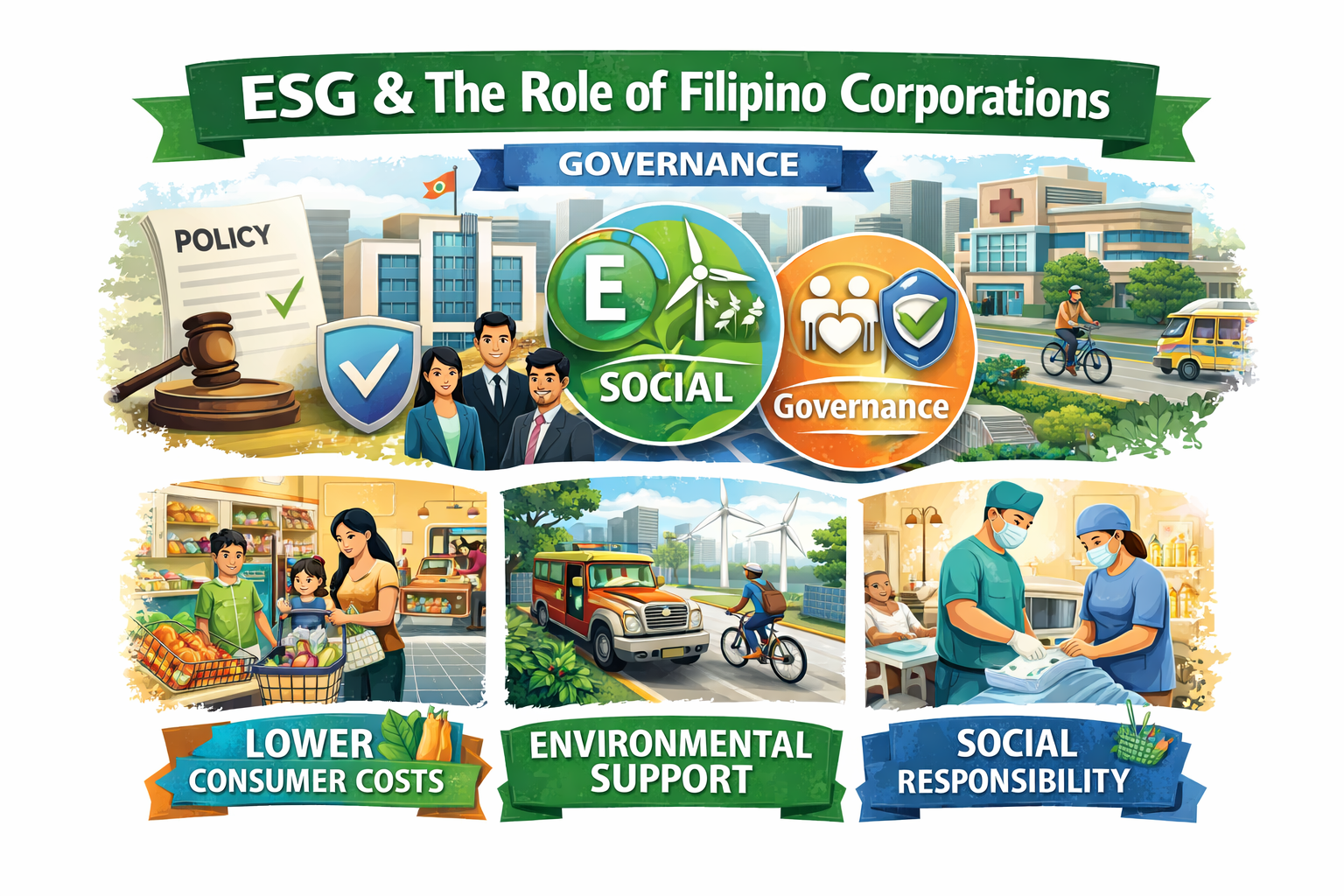
When Governance Must Lead Beyond Profit
There is something deeply uncomfortable about talking about ESG today.
On paper, corporations speak the language of sustainability. They publish reports, commit to targets, and align with global frameworks. But outside those reports, the world is under strain. Oil prices are rising, supply chains are disrupted, and vulnerable economies like the Philippines are once again absorbing the shock.
This is where ESG stops being a framework and becomes a test of character.
In our recent work, Governance and Value: A Disaggregated ESG Analysis of CFP in Philippine Publicly Listed Firms, John Paolo R. Rivera and I examined how ESG actually translates into financial outcomes. Using Philippine listed firms from 2015 to 2024, we found a clear and consistent result: governance is the strongest determinant of corporate financial performance. (PIDS)
That insight, however, carries a deeper responsibility.
If governance is powerful enough to create value, then it is powerful enough to shape how corporations respond in times of crisis.

The Oil Shock Will Make the Philippines More Vulnerable
The current global oil crisis will not hit all economies the same way.
For developed economies, it is inflation.
For the Philippines, it is erosion of already fragile household welfare.
Fuel prices affect everything. Transport costs rise. Food prices follow. Real incomes shrink. The poorest Filipino families will once again bear the heaviest burden.
This is where ESG must evolve.
We cannot continue treating ESG as a reporting exercise when society is under pressure. If governance is the anchor of firm performance, then governance must also become the anchor of social responsibility.
What Our Research Really Implies
Our PIDS study does more than identify governance as a value driver.
It reveals how each ESG pillar behaves differently:
- Governance delivers immediate and consistent financial impact
- Social investments generate lagged, long-term returns
- Environmental performance shows weaker and inconsistent links to financial outcomes (PIDS)
This means something important in today’s context.
If governance is the most responsive and actionable lever, then it must take the lead in moments of economic stress.
Not tomorrow. Not in sustainability reports. Now.
Corporate Philippines Already Has the Capacity
Philippine conglomerates are not starting from zero.
Many have already embedded sustainability into their business models. Ayala is scaling renewable energy through ACEN and committing to decarbonization. SM is investing in energy efficiency and disaster-resilient infrastructure. JG Summit is improving operational efficiency and exploring cleaner energy solutions.
These are strong foundations.
But in a crisis, foundations are not enough.
What is needed now is acceleration and intentionality.
From ESG Compliance to ESG Responsibility
In stable times, ESG is about alignment and reporting.
In difficult times, ESG must become responsibility.
Governance, as the strongest pillar, must lead this shift.
This means making decisions that go beyond profit maximization:
- Absorbing part of rising costs to protect consumers
- Preserving jobs despite margin pressures
- Supporting MSMEs within supply chains
- Expanding access to essential goods and services
It also means confronting a difficult truth.
There are moments when corporate behavior reflects efficiency.
And there are moments when it must reflect humanity.
This is the latter.
Learning from Global Waste and Conflict
There is a painful irony in today’s global landscape.
While some parts of the world are burning resources in conflict, developing economies are struggling to secure energy and maintain stability. The contrast is stark.
It reminds us that waste, at scale, is not just inefficient. It is destructive.
For a country like the Philippines, which remains highly vulnerable to external shocks, discipline in resource use and commitment to sustainability are not optional. They are survival strategies.
Corporate Philippines must recognize this.
Governance as a Force for Good
Governance is often framed as oversight, compliance, and accountability.
But in reality, governance is about decision-making power.
And in times like this, that power must be used to protect not just shareholders, but society.
Good governance today should mean:
- Transparent and fair pricing decisions
- Responsible cost management that does not disproportionately burden consumers
- Continued investment in communities and employees
- Honest reporting not just of profits, but of impact
Because ultimately, trust is built not in periods of stability, but in times of stress.
What More Can Be Done
The leading corporations of the Philippines can still do more.
Energy firms can accelerate renewable transitions to reduce dependence on imported fuel.
Retail conglomerates can stabilize prices of essential goods where possible.
Banks can extend more flexible financing to households and SMEs under pressure.
Property developers can invest in energy-efficient and cost-saving infrastructure.
More importantly, conglomerates can act collectively.
This is not just a business challenge. It is a national one.
A Final Reflection
We often say that governance drives financial performance.
But perhaps the more important question today is this:
What should governance drive when society is under pressure?
Our research provides the evidence. Governance creates value. (PIDS)
But in moments like this, value must be defined more broadly.
Not just in profits.
But in stability.
In resilience.
And in the ability of institutions to respond when people need them most.
Because in the end, markets reward performance.
But societies remember leadership.