The Hidden Economic Story Behind the Global Energy Crisis

When global conflicts erupt in the Middle East, the world immediately watches oil prices. Energy markets reacted quickly as the Strait of Hormuz was closed where 20% of oil products pass through from Iran. Tankers are rerouted. Insurance premiums rise. Commodity traders speculate on supply disruptions. Within days, gasoline prices increase across the world.
For the Philippines, however, the story goes much deeper than oil. It immediately affects the people. More specifically, it is about the millions of Filipino workers whose livelihoods are tied to the very region where global energy shocks often originate.
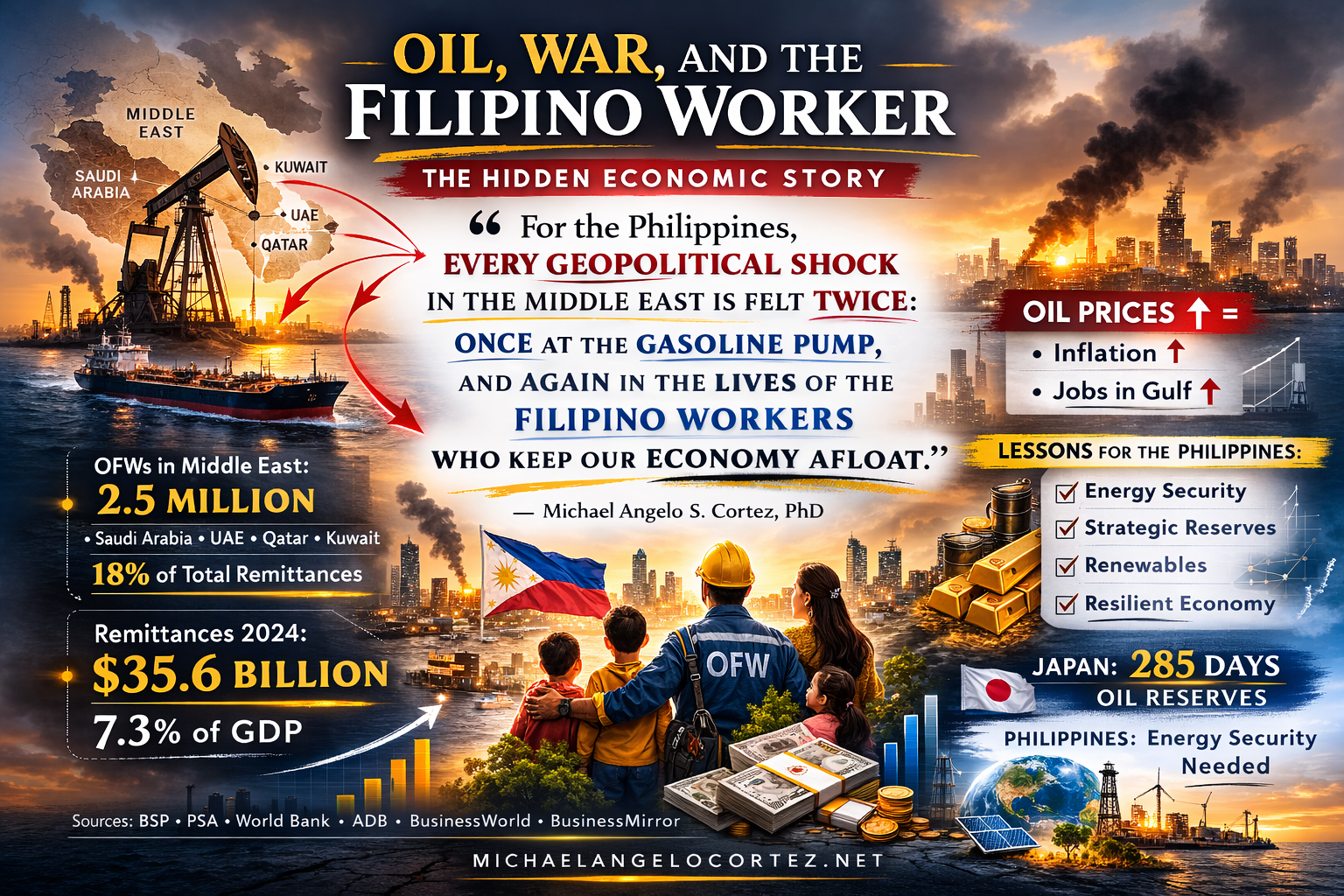
According to the Philippine Statistics Authority, there are more than 2.2 million overseas Filipino workers living and working in the Middle East. Countries such as Saudi Arabia, the United Arab Emirates, Qatar, and Kuwait have long served as major destinations for Filipino labor.
These workers play a central role in the Philippine economy. Data from the Bangko Sentral ng Pilipinas show that overseas Filipino remittances reached $35.6 billion in 2025, representing roughly 7 percent of the country’s GDP. Remittances have become one of the most stable sources of foreign exchange, supporting household consumption, education, housing, and small businesses throughout the country. In many ways, they function as an economic stabilizer.
This is why geopolitical tensions in the Middle East create a complex economic dynamic for the Philippines. The intuitive assumption is that overseas workers might return home when regional instability increases. Yet the reality is more nuanced. For many OFWs, returning home is not necessarily the safest economic option.
The deeper issue is employment opportunity.
Overseas Filipino workers often earn significantly higher wages abroad than they would domestically. Their income supports extended families, finances children’s education, and builds savings that can transform household livelihoods.
Unless there is a severe security threat, many OFWs prefer to maintain their employment abroad rather than return home without stable job prospects. This sentiment, while rarely discussed openly, reflects a practical economic calculation faced by millions of Filipino families.
The Oil Price Paradox
While rising oil prices contribute to inflation in oil-importing countries like the Philippines, they can also strengthen the economies of oil-producing states in the Middle East. Higher oil revenues often lead to expanded government spending on infrastructure, construction, and services. These sectors employ large numbers of foreign workers, including Filipinos.
In other words, the same oil shock that raises gasoline prices in Manila may simultaneously sustain employment opportunities for Filipino workers in the Gulf.
The Philippine economy therefore stands at the intersection of two global forces: energy markets and labor migration. But the crisis also exposes a deeper structural vulnerability.
The Philippines imports the vast majority of its petroleum supply. This means that every geopolitical disruption affecting global oil markets quickly translates into domestic inflation through higher transportation costs, logistics expenses, electricity prices, and food distribution costs.
This dynamic also explains the controversial debate surrounding replacement cost pricing, the pricing mechanism used in many oil markets. Under replacement cost pricing, fuel is priced according to the cost of replacing existing supply at current global market prices rather than the historical cost of previously imported fuel. The policy is designed to ensure that fuel suppliers can continue importing oil without suffering losses when global prices increase.
From a market perspective, the logic is understandable.
From a consumer perspective, however, the impact can feel immediate and unfair, particularly when fuel purchased at lower prices is sold at higher market rates. This tension illustrates the broader reality that pricing mechanisms alone cannot shield an economy that remains heavily dependent on imported energy.
Other countries have taken steps to cushion these shocks. Japan, for example, maintains strategic petroleum reserves equivalent to roughly 285 days of national consumption. These reserves allow governments to stabilize domestic markets during supply disruptions and prevent sudden price spikes from affecting households and industries.
Strategic reserves serve as an economic buffer against geopolitical uncertainty.
For the Philippines, the lesson is clear.
Energy security must become a long-term national priority.
This includes several key strategies: responsible exploration of domestic energy resources, expansion of geothermal energy capacity, investments in renewable technologies, and the gradual transition toward more fuel-efficient transportation systems including electric vehicles.
Geothermal energy represents a particularly important opportunity. The Philippines already ranks among the world’s leading producers of geothermal power. Expanding this capacity could significantly reduce dependence on imported fossil fuels while providing stable baseload electricity.
Should we tap into our gold reserves?
Historically, central banks treat gold as a financial safety net rather than a first line policy tool. Countries facing severe economic distress have sometimes sold gold to obtain foreign currency liquidity. Venezuela and Turkey, for example, have periodically mobilized gold reserves to manage financial pressures.
Yet selling gold is typically viewed as a measure of last resort.
Gold reserves function as an insurance policy that supports currency credibility and financial stability. Liquidating them to address temporary price shocks can weaken long-term economic confidence.
In many cases, central banks around the world have actually been accumulating gold reserves rather than selling them, particularly during periods of geopolitical uncertainty.
The deeper lesson from the current crisis is therefore not simply about oil prices or commodity markets.
It is about resilience.
Countries that diversify their energy sources, build strategic reserves, and strengthen domestic economic opportunities are better positioned to withstand global shocks.
Energy policy, labor migration, and financial stability are more interconnected than they often appear. Behind every fluctuation in oil prices are families, workers, and communities whose lives are shaped by forces far beyond their control.
For the Philippines, the Middle East crisis is therefore not only an oil story. It is also a remittance story.
And ultimately, it is a story about the resilience of Filipino workers who continue to navigate the uncertainties of a global economy while sustaining the families and communities that depend on them.
References
Philippine Statistics Authority (PSA). Overseas Filipino Workers Statistics.
Bangko Sentral ng Pilipinas (BSP). Overseas Filipino Remittances Data.
BusinessWorld. Philippine Remittance Reports and Energy Market Analysis.
BusinessMirror. Middle East Conflict and Remittance Monitoring Reports.
Asian Development Bank (ADB). Asian Economic Outlook.
World Bank. Migration and Remittances Data.