I never gave it a name. I never treated it like a person. But over the past year, artificial intelligence has become a silent fixture in my daily life. Sometimes helpful, often frustrating, always there.
What began as curiosity has turned into something more routine. AI now sits quietly at the corner of my academic desk and personal space—offering suggestions, formatting equations, simplifying paragraphs, or occasionally making up entire references I never asked for.
Let me tell you about our relationship. It’s complicated, but instructive.
In the Office: Structure, Models, and a Lot of Corrections
As a researcher, my work is built on structure and logic. I use panel data, variable frameworks, and models that span time and industry. When I started using AI, I thought it could help me write faster, think clearer, and automate routine parts of my workflow. And sometimes, it does.
I ask it to write out hypotheses, generate regression equations, interpret outputs, or clean up academic language. It responds with polite confidence. But often, that confidence is misplaced. It forgets what I said earlier. It loses track of how the models are built. It simplifies what should be complex. And it creates references that never existed.
So I adjusted. I gave it structured prompts. I tracked its errors. I reissued instructions like a researcher training a junior assistant. I repeated myself with the calm of someone who knows that machines do not learn unless you teach them over and over again.
And when it failed completely, I refreshed. I closed the session. I started again.
On the Road: Thinking with a Voice Beside Me
Surprisingly, one of the most productive ways I use AI is not at my desk. It is while I am driving.
In the solitude of long drives between campuses or consultations, AI becomes a quiet thinking companion. I speak my thoughts aloud. I brainstorm research questions, outline conceptual frameworks, and even rehearse how to explain theories to students. AI listens, prompts, and asks questions back.
It helps keep my attention sharp. It helps organize the flood of ideas I often carry while navigating both highways and hypotheses. And in those moments, I am reminded that the tool is not just about output—it is also about rhythm. Sometimes, what we need is not silence, but structured reflection. AI provides that, even without understanding it.
It does not distract. It does not judge. It simply listens and responds. And sometimes, that is enough to move a rough idea into a usable draft later on.
In the Field: Humor, Reflection, and a Quiet “Sorry”
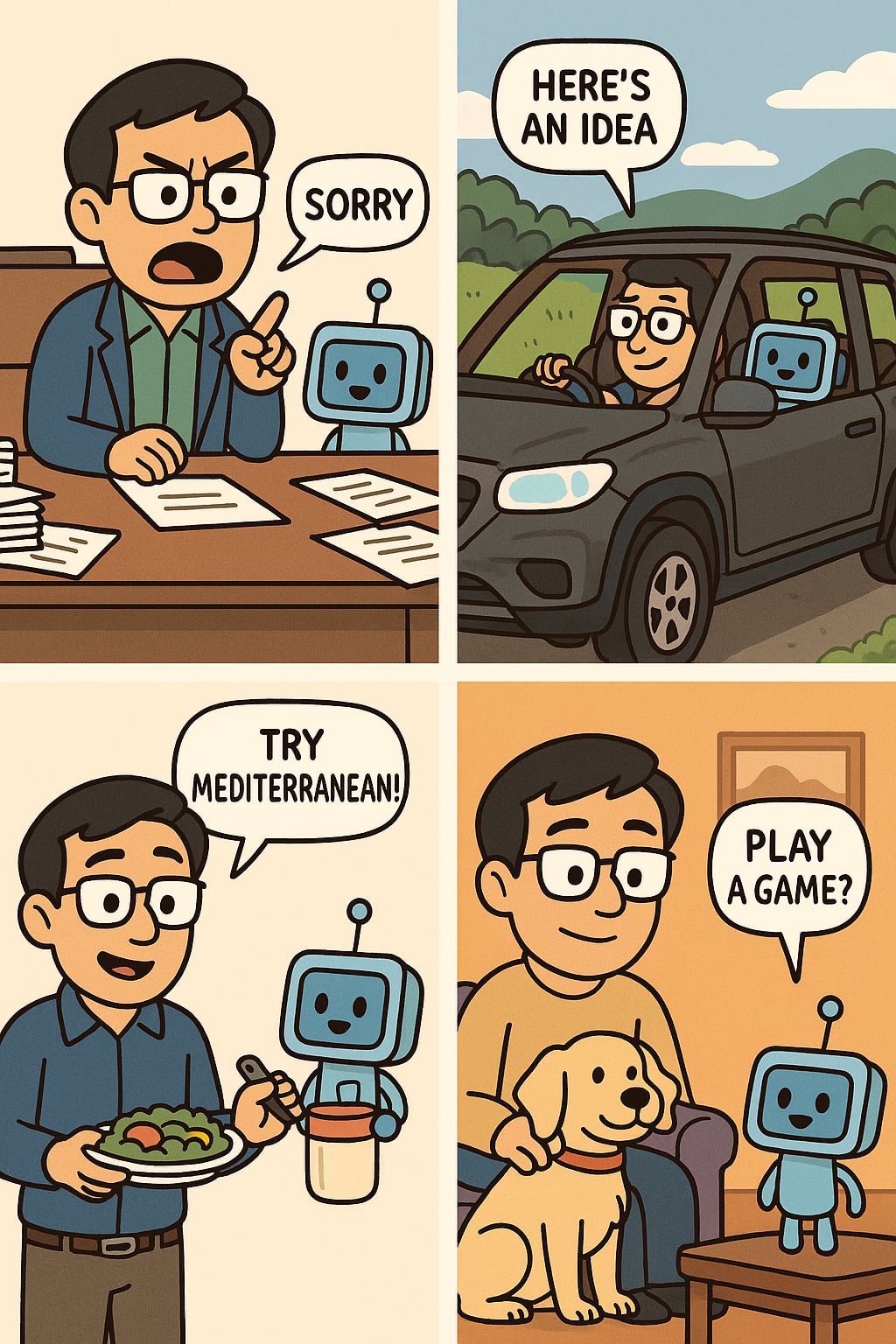
Over time, I began to find humor in my exchanges with AI. When it summarizes too much, I scold it. When it forgets my previous session, I sigh. When it completely misses the point, I imagine it nervously raising its digital hand, saying “Sorry.”
I even began drawing cartoon scenes: me at my desk, frustrated. The AI beside me with a wide-eyed face and an apology bubble. Another scene where I’m pacing with deep concentration while it takes notes, pretending to understand my thinking. These visual sketches are light-hearted, but they reflect something deeper—the difference between generating and understanding.
AI does not comprehend. But it does not complain either.
Outside the Desk: Where AI Cannot Follow
Beyond work, AI stays in the background. It has no place in the silence of early mornings, or the stillness of Villa Alvero. It does not understand what it means to be comforted by Basha’s presence. It cannot process the grounding effect of planting something, watering it, and watching it grow.
AI has no sense of time. No sense of consequence. No memory of fatigue. It is available at any hour, but absent from every moment that matters.
And that is where the line must remain.
When the Lights Shut Off: Staying Grounded in Reality
Eventually, the screen turns black. The network disconnects. The battery dies. The signal drops. And when that happens, AI has nothing to say.
That is when real life begins again.
In the quiet that follows, I return to the tangible: the weight of a pen, the feel of paper, the sound of birds outside my window. I speak to my dog, not my device. I think with silence, not prompts. I remember that I am not just a researcher managing variables, but a human being who needs rhythm, rest, and reflection.
This is what grounds me. Not code. Not response time. Not algorithms. But moments that do not depend on electricity to exist.
The Lesson: Use It, But Never Trust It Fully
After one year of using AI in both my professional work and my daily thinking, I have found a rhythm. I prompt deliberately. I validate outputs. I watch for hallucinations. I reissue commands when memory fails. I keep the human hand firmly on the wheel.
And when the tool falls apart—when it oversimplifies, contradicts itself, or creates confusion—I pause. I do not argue. I refresh. I begin again.
The machine does not mind. It does not feel rejected. It does not need praise. It does not have a heart.
And for that reason, it is not worth your hypertension.
But if I may offer a final comparison—it is this.
AI is nothing like Basha.
Basha keeps me company too. She stays nearby when I work late into the night, and follows me when I walk into another room. She listens, sometimes. She obeys, most of the time. But she also has her moments. The little flashes of stubbornness, the sideways glances, the unspoken attitude when I ask her to move from my chair. She is not programmable. She has moods. She responds with feeling.
And yet, I forgive her easily. Because she has a heart.
That is the difference.
AI will never know how it feels to be truly loyal, truly annoyed, or truly forgiven. It will never give companionship that understands silence. It will never replace the presence of something real, breathing, and alive.
And that is why I keep Basha close.
The machine may assist. But only the living can keep you company.